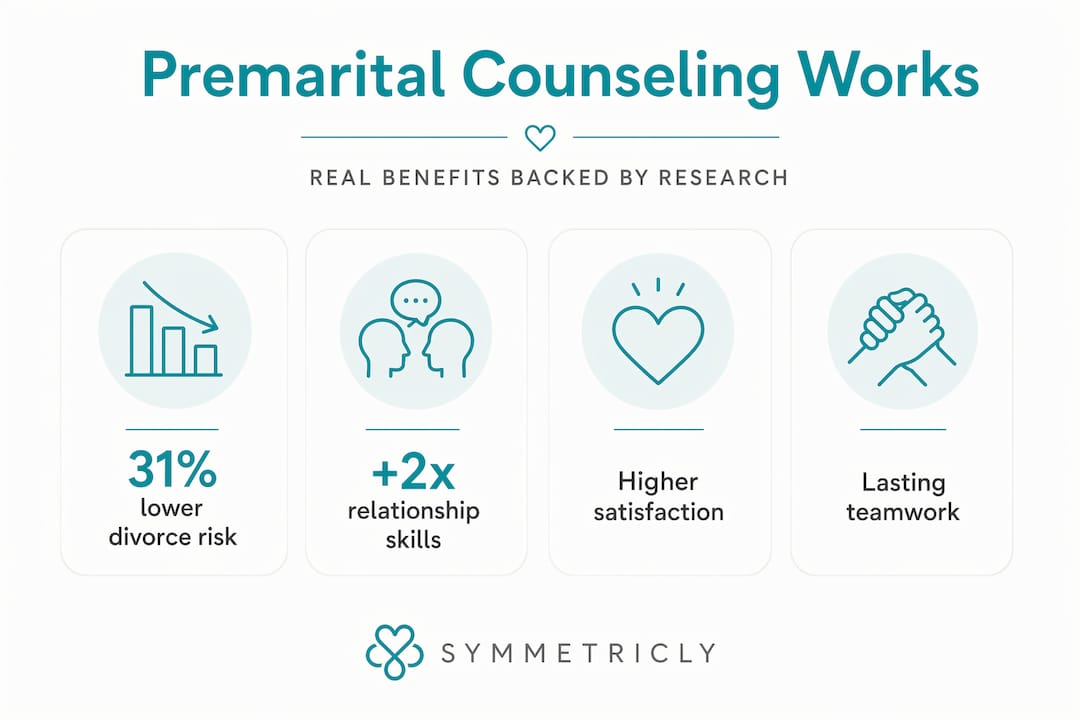
Most couples spend more time planning their wedding than preparing for the actual marriage. That gap is where so many relationships quietly start to crack. Understanding why couples therapy before marriage matters isn’t about assuming something is wrong. It’s about recognizing that communication under pressure is a skill, and skills require practice. Research shows premarital counseling lowers divorce risk by 31%. That single statistic reframes everything. This isn’t crisis management. It’s one of the smartest investments you can make before saying “I do.”
Table of Contents
- Key takeaways
- Why couples therapy before marriage matters
- The evidence behind premarital counseling
- What you actually work on in sessions
- When to start and how to approach it
- How premarital counseling prepares you for the long haul
- My honest take on why this matters so much
- Start your marriage on solid ground with Joinsymmetricly
- FAQ
Key takeaways
| Point | Details |
|---|---|
| Prevention beats repair | Premarital counseling addresses patterns before they become entrenched, making change far easier. |
| Divorce risk drops significantly | Couples who complete premarital counseling show a 31% lower risk of divorce or separation. |
| Timing shapes outcomes | Starting 3 to 6 months before marriage gives couples enough time to practice new skills meaningfully. |
| Skills are the real product | You leave counseling with communication tools, not just conversations, that carry you through decades of challenges. |
| Therapy normalizes asking for help | Couples who go before marriage are more willing to seek support again when life gets hard. |
Why couples therapy before marriage matters
Premarital counseling is not a warning sign. It’s a starting point. The goal isn’t to uncover problems but to build the skills and shared understanding that make a marriage genuinely work over time.
Most premarital counseling programs run 6 to 8 sessions, ideally beginning 3 to 6 months before the wedding. That timeline isn’t arbitrary. It gives couples enough space to practice what they learn between sessions, absorb feedback, and actually shift their patterns before the pressure of the wedding arrives.
What happens in those sessions? A lot more than you might expect. A skilled counselor will guide you through topics that couples often avoid until they become arguments. Here’s what typically gets covered:
- Communication styles: How each of you expresses needs, frustration, and affection, and where those styles clash
- Finances: Spending habits, debt, saving goals, and who manages what (one of the top drivers of marital conflict)
- Family expectations: How your families of origin shaped your assumptions about marriage, roles, and holidays
- Children: Whether you want them, when, how many, and how you’ll parent
- Conflict patterns: What happens when you disagree, who shuts down, who escalates, and how to de-escalate
- Shared values: What you each believe about faith, purpose, and what a good life looks like
The contrast with crisis therapy is worth noting. When couples enter therapy after years of resentment and repeated conflict, a therapist is working against entrenched habits. Premarital counseling starts with goodwill on both sides. You’re not trying to fix damage. You’re building something intentional from the beginning.
The evidence behind premarital counseling
The research on this topic is genuinely encouraging, and it’s specific enough to take seriously.
The most cited figure is that couples who complete premarital counseling are 31% less likely to divorce or separate than those who don’t. That’s not a small margin. For context, that’s a stronger protective effect than many people expect from a handful of sessions.
| Benefit | What research shows |
|---|---|
| Divorce risk reduction | 31% lower risk compared to couples without premarital counseling |
| Communication improvement | Couples report better conflict resolution and emotional expression after counseling |
| Long-term satisfaction | Gottman research links early skill-building to higher satisfaction decades later |
| Therapy effectiveness | Couples therapy outperforms no intervention in 70 to 80% of cases when started early |
The mechanism matters here. Early intervention works because negative communication patterns, things like contempt, defensiveness, and stonewalling, haven’t had years to calcify. When you practice healthier habits before those patterns take root, you’re working with the relationship’s natural momentum rather than against it.
One important caveat: the quality of the program matters. A single pre-wedding conversation with a pastor is not the same as an evidence-based program with repeated practice exercises. Durable improvements come from repeated skills practice and structured assessment, not one-time discussions.
Pro Tip: When evaluating premarital counseling options, ask whether the program includes structured exercises and assessments between sessions. Programs that assign real practice outside the therapy room tend to produce stronger, longer-lasting results.
What you actually work on in sessions
The topics covered in premarital therapy aren’t just conversation starters. They’re structured skill-building exercises designed to prepare you for real-world pressure.

One of the most valuable things a counselor does is create a neutral structured space to talk about high-stakes subjects without the heat of an active fight. You’re not discussing finances because you just overdrew the account. You’re discussing them calmly, with a guide, before that moment ever arrives.
Here are the core skills most evidence-based programs teach:
- Active listening: Fully hearing your partner’s perspective before responding, not just waiting for your turn to talk
- Expressing needs clearly: Learning to say “I need more reassurance when we’re stressed” instead of “You never pay attention to me”
- De-escalation techniques: Recognizing when a conversation is heating up and knowing how to pause without shutting down
- Repair attempts: Small gestures and phrases that interrupt a conflict cycle before it spirals
- Decision-making frameworks: How you’ll make big decisions together, who has final say in which domains, and how you’ll handle genuine disagreement
Values alignment is often the most revealing part of the process. Premarital counseling helps couples align on children, finances, roles, and core values before those become dealbreakers. Discovering that you have different visions for how many kids you want is a much easier conversation at month four of counseling than at year three of marriage.
There’s also a longer-term benefit that often goes unmentioned. Premarital counseling normalizes help-seeking behavior. Couples who go before marriage are significantly more likely to return to therapy when life throws something hard at them, because they’ve already learned that asking for support is a strength, not a failure.
Pro Tip: Don’t wait for a topic to feel urgent before bringing it up in a session. The whole point of premarital counseling is to address things before they’re on fire. Bring your quiet worries, not just your obvious conflicts.
When to start and how to approach it
Timing is one of the most practical questions couples ask, and the answer is simpler than most people think.
- Aim for 3 to 6 months before the wedding. This is the optimal window because it gives you time to complete a full program and practice skills before the stress of the wedding itself peaks.
- Earlier is always better. If you’re engaged and still a year out, start now. You’ll have more time to absorb what you learn and revisit topics as your relationship evolves.
- Don’t dismiss it because things feel good. The couples who benefit most from premarital counseling are often the ones who feel like they don’t need it. Goodwill and low conflict are assets in therapy, not reasons to skip it.
- Address partner reluctance directly. If one of you is hesitant, name it. A lot of resistance comes from the fear that going to therapy means something is wrong. Reframe it as preparation, the same way you’d prepare financially or logistically for a major life change.
- Choose a program, not just a conversation. A single session or a casual talk with a mentor won’t produce the same results as a structured program. Look for a counselor who uses evidence-based approaches and includes skill practice between sessions.
The life transitions around marriage are significant. Getting support during that window isn’t a sign of weakness. It’s a sign that you take the relationship seriously enough to invest in it.
How premarital counseling prepares you for the long haul
The wedding is one day. The marriage is every day after it. And those days will include real stressors that no amount of love alone fully prepares you for.
Here’s what premarital counseling actually equips you to handle:
- Financial strain: Job loss, unexpected expenses, and disagreements about spending are among the most common sources of marital conflict. Couples who’ve already built a communication framework handle these moments with less damage.
- Parenting differences: Even couples who agree on wanting children often discover sharp differences in parenting philosophy. Working through those differences before a baby arrives is far easier than mid-crisis.
- Family dynamics: Extended family pressure, differing holiday traditions, and loyalty conflicts with in-laws become much more manageable when you’ve already established shared boundaries and decision-making habits.
- Identity shifts: Marriage changes how people see themselves. Careers shift, friendships evolve, and personal goals realign. Couples who’ve practiced honest communication adapt to these changes without losing each other.
Premarital counseling teaches couples constructive emotional communication that reduces long-term resentment. That’s not a small thing. Resentment is one of the quietest and most corrosive forces in a marriage. Catching it early, or better yet preventing it from building in the first place, is what gives relationships the kind of staying power that still looks good twenty years in.
The mindset shift premarital counseling creates is also worth naming. Couples who go through it tend to see their relationship as something that needs ongoing attention, not something that runs on autopilot once the vows are exchanged. That proactive orientation is one of the strongest predictors of long-term relationship health.
My honest take on why this matters so much
I’ve seen what happens when couples wait. They come in after years of the same argument cycling through different topics, and the work is so much harder because the patterns are so deeply grooved. Changing behavior when resentment is already present requires dismantling something. Premarital counseling builds something instead.
What surprises me most is how many genuinely loving, well-matched couples underestimate how much communication under stress is a skill. They assume that because they love each other and rarely fight, they’ll figure it out when things get hard. Sometimes that’s true. But often, the first major stressor, a job loss, a miscarriage, a difficult in-law situation, reveals that they never actually learned how to talk through something painful together.
I think of premarital counseling as relationship insurance. Not because something is likely to go wrong, but because the cost of not having it, when something does, is so much higher than the investment upfront. Premarital counseling reduces time, emotional pain, and conflict costs in future marriage challenges. That’s not a sales pitch. That’s what the research consistently shows.
If you’re on the fence, consider this: the couples who tell me they wish they’d come sooner far outnumber the ones who say they came too early.
— Janelle
Start your marriage on solid ground with Joinsymmetricly
If you’re thinking about marriage and wondering whether now is the right time to get support, the answer is almost always yes.
Joinsymmetricly offers specialized premarital counseling in Smyrna and across Georgia, designed to help couples build the communication skills and emotional alignment that make marriages genuinely thrive. The approach goes beyond surface-level conversation. It focuses on identifying where your hearts, minds, and values are in sync, and where a little intentional work now can prevent a lot of pain later. Joinsymmetricly accepts major insurance plans and offers flexible payment options, so getting started is more accessible than you might think. You can also explore the full range of relationship support services to find the right fit for where you are right now.
FAQ
What does premarital counseling actually involve?
Premarital counseling typically runs 6 to 8 sessions and covers communication skills, finances, family expectations, values, and conflict resolution. It focuses on skill-building and alignment rather than addressing existing crises.
Should we go to therapy before marriage if things are going well?
Yes. Couples therapy before marriage is most effective when goodwill is high and negative patterns haven’t formed yet. Strong relationships benefit from the communication tools just as much as struggling ones do.
How does premarital counseling impact divorce rates?
Research shows that couples who complete premarital counseling have a 31% lower risk of divorce or separation compared to those who don’t, making it one of the most evidence-backed preventive investments a couple can make.
When is the best time to start premarital counseling?
The ideal window is 3 to 6 months before the wedding, though starting earlier is always better. Even couples who begin counseling after marriage can benefit from the communication skills and frameworks it teaches.
Does premarital counseling help with long-term relationship satisfaction?
Yes. Gottman’s research shows that couples who build communication skills early report significantly higher satisfaction and lower divorce rates decades into their marriage.
Recommended
- Relationships | Symmetricly
- 7 Signs It’s Time for Couples Counseling in Atlanta
- Smyrna Couples Counseling | Relationship Therapy in Smyrna, GA
- Marriage After Infidelity: Ways Atlanta Couples Heal
Article generated by BabyLoveGrowth
