You can love someone deeply and still feel like you’re talking past them. Most couples don’t struggle because they don’t care. They struggle because nobody taught them how to improve couples communication skills in a way that actually holds up under pressure. Misunderstandings pile up. Small arguments turn into recurring battles. Emotional distance creeps in quietly. The good news is that communication is a skill, not a personality trait. You can learn it, practice it, and get genuinely better at it together.
Table of Contents
- Key takeaways
- How to improve couples communication skills from the ground up
- Practical exercises to strengthen your relationship dialogue
- Navigating communication breakdowns and recurring conflict
- Signs your communication is genuinely improving
- My honest take on what actually moves the needle
- How Joinsymmetricly can support your next step
- FAQ
Key takeaways
| Point | Details |
|---|---|
| Active listening comes first | Reflecting back what your partner says reduces defensiveness and builds real understanding. |
| “I” statements reduce blame | Framing feelings around your own experience keeps conversations from turning into accusations. |
| Most conflicts don’t fully resolve | Nearly 69% of relationship conflict is perpetual, so connection matters more than winning. |
| Structured exercises build habits | Timed sharing and open-ended questions create consistent, low-pressure communication practice. |
| Early support accelerates progress | Seeking couples therapy before a crisis strengthens communication and prevents deeper damage. |
How to improve couples communication skills from the ground up
Before you try any technique, you need the right foundation. Think of it like learning to cook. You can follow a recipe perfectly, but if you’re rushing, distracted, or defensive about feedback, the meal still suffers.
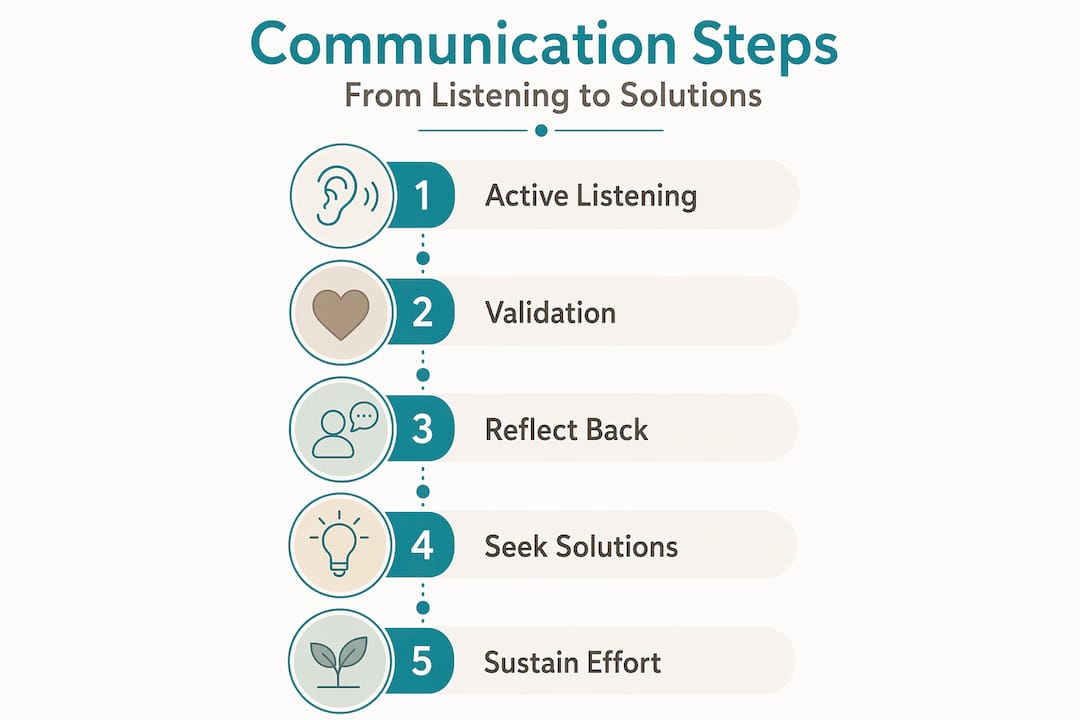
Active listening is the single most underused skill in relationships. It’s not just waiting for your turn to speak. It means giving your full attention, making eye contact, and reflecting back what you heard. Something like, “So what I’m hearing is that you felt ignored when I didn’t respond to your text. Is that right?” That one sentence does more for connection than a 20-minute explanation of your own perspective.
Using “I” statements changes the entire tone of a conversation. Instead of “You never listen to me,” try “I feel unheard when I’m talking and you’re on your phone.” These skills keep partners on the same page and reduce defensiveness during difficult moments. The shift is small in words but enormous in impact.
Here are the core skills worth building before anything else:
- Emotional regulation: Take a breath before responding when you feel triggered. Reactions made in a flooded emotional state rarely land well.
- Nonverbal awareness: Your tone, posture, and facial expressions communicate as much as your words. Empathy and patience create the safety your partner needs to open up.
- Validation: You don’t have to agree with your partner’s feelings to acknowledge them. Saying “That makes sense given what you’ve been through” is not surrender. It’s connection.
- Patience with the process: Couples who expect effort in their relationship experience more satisfaction and resilience than those who expect things to feel easy.
Pro Tip: Before a difficult conversation, agree on a simple ground rule: no interrupting until the other person signals they’re done speaking. This one rule alone can cut defensiveness in half.
Practical exercises to strengthen your relationship dialogue
Knowing the skills is one thing. Practicing them regularly is what actually changes your relationship. These exercises are designed to fit into real life, not just therapy sessions.
Open-ended question nights. Once a week, set aside 20 minutes where you each ask one open-ended question. Not “How was your day?” but “What’s something that’s been on your mind lately that you haven’t shared with me?” This deepens conversation in ways that everyday check-ins rarely reach.
Reflective listening rounds. One partner speaks for two to three minutes on a topic, anything from work stress to a childhood memory. The other listens without interrupting, then paraphrases what they heard before responding. This exercise builds the habit of truly absorbing what your partner says before reacting.
Timed sharing sessions. Using turn-taking and structured prompts helps partners engage without escalation. Set a timer for five minutes each. No cross-talk, no rebuttals during the other person’s time. Just speaking and being heard.
Safety cue agreements. Agree on a signal, like holding up a hand or saying “pause,” that either of you can use when a conversation is getting too heated to continue productively. This isn’t avoidance. It’s a commitment to return to the topic once both of you are calmer.
Follow-up check-ins. If your partner shares something meaningful, circle back to it the next day. A simple “Hey, how are you feeling about what you shared last night?” goes a long way. Following up satisfies your partner’s need to feel like they matter, not just in the moment but over time.
Pro Tip: Try the reflective listening exercise on a low-stakes topic first, like a favorite memory or a recent win at work. Building the muscle in calm moments makes it much easier to use when emotions are running high.
Here’s a quick comparison of two common approaches couples take when conflict arises:
| Approach | What it looks like | What actually happens |
|---|---|---|
| Problem-solving mode | Jumping to solutions before your partner feels heard | Partner feels dismissed, conflict escalates |
| Validation-first mode | Acknowledging feelings before offering solutions | Partner feels safe, conversation stays open |
The difference isn’t about being passive. It’s about sequencing. Validation first, solutions second.
Navigating communication breakdowns and recurring conflict
Here’s something most couples find uncomfortable to hear. Nearly 69% of relationship conflict comes from perpetual issues that may never fully resolve. Different spending habits. Different needs for alone time. Different approaches to parenting. These aren’t problems you fix. They’re differences you learn to manage together.
That realization changes everything about how you approach conflict. If you go into an argument expecting to “win” or permanently solve the issue, you’ll keep feeling frustrated. If you go in hoping to feel understood and to understand your partner better, you’ll almost always leave the conversation closer than when you started.
Avoiding difficult dialogue is one of the most damaging patterns a couple can fall into. Stonewalling, shutting down, changing the subject. These feel like self-protection in the moment, but they create distance that compounds over time. Resentment builds quietly. By the time it surfaces, it’s carrying months or years of weight.
Here’s what actually helps when a conversation breaks down:
- Slow the pace. When voices get louder, consciously lower yours.
- Name what’s happening without blame. “I notice this is getting heated. Can we take ten minutes and come back?”
- Shift the goal from being right to being connected. Ask yourself, “Do I want to win this argument or keep this relationship strong?”
- Recognize when you’re in a recurring conflict pattern and name it together instead of fighting inside it.
“The goal of communication isn’t agreement. It’s understanding. When both partners feel genuinely heard, the need to fight for a ‘win’ often disappears on its own.”
Knowing when to get outside support is also part of good couples conflict resolution skills. Seeking therapy early improves long-term relationship quality and reduces conflict. You don’t have to be in crisis to benefit from a professional perspective.
Signs your communication is genuinely improving
Progress in communication doesn’t always feel dramatic. Sometimes it’s quiet. A conversation that used to end in silence now ends with both of you feeling lighter. That’s real progress.
Here are some markers to watch for as you work on better communication in marriage or long-term partnership:
| Sign of progress | What it means in practice |
|---|---|
| Feeling heard more often | Your partner reflects your words back accurately and without dismissal |
| Fewer misunderstandings | You’re asking clarifying questions instead of assuming intent |
| Willingness to bring up hard topics | Emotional safety is growing; you trust the conversation won’t spiral |
| Shorter recovery time after conflict | You’re repairing faster because you’ve built the skills to do it |
| Stronger sense of closeness | Consistent, honest dialogue builds the kind of intimacy that lasts |
The most honest thing you can hear about improving relationship conversation is this: it takes sustained effort. There’s no point at which you’re “done.” But couples who commit to the practice consistently report not just fewer arguments, but a deeper sense of being truly known by their partner. That’s the real reward.
My honest take on what actually moves the needle
I’ve spent years working with couples who come in convinced the problem is their partner. “If they would just listen,” or “If they would just stop getting so defensive.” What I’ve learned is that the shift almost never starts with the other person. It starts with you deciding to stop trying to be understood and starting to try to understand.
The uncomfortable truth I’ve seen play out over and over is that most couples are fighting about the same three or four things for years. Not because they’re incompatible, but because they’re trying to solve feelings with logic. Your partner doesn’t need you to fix the situation. They need to know you get why it hurts.
What I’ve found actually works is the follow-up habit. It sounds almost too small to matter. But when you circle back the next day and say, “I was thinking about what you shared last night,” something shifts. Your partner stops feeling like they have to fight for your attention. The listening and validation that happens in those small moments builds more trust than any big conversation.
I also believe strongly in getting support before things feel broken. The couples I’ve seen make the most lasting progress are the ones who came in curious, not desperate. They wanted to grow, not just survive.
— Janelle
How Joinsymmetricly can support your next step
If you’ve been reading this and recognizing patterns in your own relationship, that awareness is worth acting on. Real change happens faster with the right support alongside you.
Joinsymmetricly offers couples therapy in Smyrna and across Georgia, with a focus on relationship alignment rather than just conflict management. Their approach goes deeper than surface-level techniques. It looks at where your emotional, mental, and values-based connection may be out of sync, and helps you rebuild from there. They also offer a free relationship health assessment so you can see exactly where your strengths are and where you’d benefit most from attention. Whether you’re navigating a rough patch or simply want to grow closer, their team is ready to meet you where you are. Major insurance plans are accepted, and flexible payment options make it accessible for most couples. If you’re wondering whether now is the right time, check out 7 signs it’s time for couples counseling to help you decide.
FAQ
What are the most effective strategies for couples communication?
Active listening, using “I” statements, and validation-first responses are among the most research-backed strategies for couples communication. Practicing structured exercises like timed sharing and reflective listening builds these habits over time.
How do you improve communication in a marriage without it feeling forced?
Start with low-stakes conversations using open-ended questions, then gradually apply the same skills during harder topics. Consistency matters more than perfection, and small daily habits like following up on what your partner shared create natural momentum.
Why do couples keep having the same arguments?
Nearly 69% of relationship conflict is perpetual, meaning it stems from core differences that may never fully resolve. The goal shifts from solving the issue to understanding each other better within it.
When should couples seek professional help for communication issues?
You don’t need to be in crisis to benefit from therapy. Seeking support early improves long-term relationship quality and helps couples build skills before patterns become deeply entrenched.
What is reflective listening and why does it matter for couples?
Reflective listening means paraphrasing what your partner said before responding, which confirms you understood them correctly. It reduces defensiveness and is one of the most direct ways to make your partner feel genuinely heard during difficult conversations.
Recommended
- Communication Breakdowns in Relationships | Symmetricly
- Smyrna Couples Counseling | Relationship Therapy in Smyrna, GA
- Relationships | Symmetricly
- Janelle Dawsey, LMFT
Article generated by BabyLoveGrowth
